|
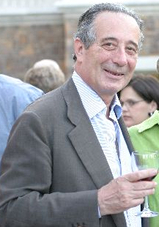
| Ferdinando Frescobaldi |
When Ferdinando Frescobaldi was vacationing a couple of weeks back in Barbados, he had a meal with Tony and Cherie Blair. Britain 's best-known couple, who are known for their fondness for the wines of Montalcino, where the Frescobaldis own the Luce Estate, kept talking about the West Indies . Frescobaldi figured out that they talking about the Caribbeans, but he couldn't resist saying that he'd be visiting the East Indies in the coming week.
I don't whether Frescobaldi sense the irony of the occasion, but here was a man bearing his family name dining with the British Prime Minister, 1,000 years after an ancestor of his, who was one of the world's earliest bankers, started lending money to English kings to wage wars. One of the kings refused to pay and when one of the banker Frescobaldis asked him to repay his head, the royal demanded his head. With great difficulty the man escaped the angry king and his country and settled into the more civilised profession of wine-making. The Blairs were unwittingly making up for the king's historical act of injustice.
Ferdinando Frescobaldi may not have dined with the Prime Minister in New Delhi , but the patrician “humble farmer” charmed the swish ladies who were served the heavenly drops from his family's Tuscan estates. They were quite in the dark about merlot, but they loved the Lamaione 2000, a 100% merlot from Castelgiocondo, the Frescobaldi estate in Montalcino. And they asked a lot of questions.
This intense thirst for wine knowledge confirmed Frescobaldi's gut feeling that he was right in setting apart an allocation for India . “Indians are travelling more and more, and international tourists are arriving in greater numbers, so you are getting exposed to the global lifestyle,” observed Frescobaldi, who has been seeing India since 1971.
He drew a parallel between India and Italy – both countries have long histories, but both are open to change. “You are more open to accepting the best of each country,” he said, and then he made a political statement, which made a lot of sense in these difficult times. “If we have an open world, we will understand each other so much better,” said the Frescobaldi Vice-President.
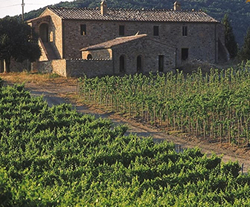 |
| The Luce Estate in Montalcino, which started as a joint venture between the Frescobaldis and the Mondavis, but is now owned 100% by the Italians following the Mondavi acquisition by the Constellation Brands |
Frescobaldi knows India better than most Italians because his eldest brother, Dino, is a respected Italian commentator on international affairs who was associated with Pandit Jawaharlal Nehru, Josip Broz Tito and Gamal Abdel Nasser, the founders of the Non-Aligned Movement. Dino's daughter, Tiziana, handles the media for the Frescobaldis; Ferdinando's elder brother, Vittorio, heads the firm; his younger brother, Leonardo, is also a vice-president. Vittorio's son Lamberto, a UC Davis grad, is the wine-maker at Luce Estate, the Frescobaldi-Mondavi joint venture in Montalcino that is now owned 100% by the Italian company following the Mondavi acquisition by the US-based Constellation Brands.
When we were on the subject of Luce, Frescobaldi took out his Blackberry to show me a long message – actually, it was a media release – from Michael Mondavi announcing the purchase of the Carneros Creek Winery from founders Francis and Kathleen Mahoney. The purpose of this exercise was to show how the Mondavis are still in touch with the Frescobaldis, though the Italians took 100% control of the Luce Estate after Robert Mondavi sold out to Constellation Brands.
The idea of Luce was born in 1994 because Tim Mondavi wanted to replicate the success of his father Robert's joint venture with the Rothschilds to produce Opus One. Luce, a delectable yet unprecedented (for Montalcino) marriage of Sangiovese and Merlot, is entirely the baby of Tim Mondavi and Lamberto Frescobaldi, and the wine is gaining many more supporters with each passing year. “We are not just controller of shares,” Frescobaldi says. “We see ourselves as the custodians of the crown jewels. Our wine philosophy is to respect the region and to continue to produce a wine that's the best.” This isn't just another marketing spiel.
It was at Luce – of the 192 hectares on this estate located to Montalcino's south-west, just 16.5 are under vine – that the Frescobaldi practices of high-density plantation and rigorous pruning of each vine to reduce the grape output have evolved. The family eventually will bring another 20 hectares under vine to cope with the international demand.
“We have changed the way we manage our vineyards,” declares Ferdinando. “We grow 6,000-6,500 vines per hectare and have reduced yields to 1,000-1,200 gm of grapes per vine. In other words, each vine produces just enough for one bottle of wine.” Then, he says something that strikes me as very gentlemanly: “The Mondavis stimulated us with their international experience,” says the man who inherited, along with brothers Vittorio and Leonardo, the family mantle rather unexpectedly after his father's abrupt death in 1958. In these 48 years, the three brothers heading the company have ensured that the company progresses “in all directions”.
“Today, we pay great attention to the soil. We make sure we do not extract too much from the soil by following an organic, balanced approach. Otherwise, the soil will get exhausted,” says the soft-spoken man with a gentle sense of humour. “You have a pill only when you have a headache, don't you?” he says, making his views on human intervention in agriculture very clear.
Our conversation steers to Tenuta dell'Ornellaia, which originally belonged to Lodovico Antinori, Piero Antinori's extravagant and estranged brother, famous for his love of girls and gadgets. (Piero, incidentally, is one of Ferdinandino's four or five closest friends.) The estate in Bolgheri, 96 km south-west of Florence, is famous for its Ornellaia, a cabernet-merlot blend that Lodovico created with his wine-maker Tibor Gall.
The wine is treated now with the same respect as the Sassicaia, a masterpiece created by Giacomo Tachis, Antinori's talented wine-maker, for the nobleman's uncle, Mario Incisa della Rocchetta. Lodovico's Masseto, a 100% merlot, commands a rock star status. The phenomenal success of uncle and nephew has attracted Piedmontese star Angelo Gaja to Ca'Marcanda as well as Piero himself, who produces the superlative Guado al Tasso in Bolgheri.
But Lodovico's playboy lifestyle made him perennially cash-strapped, which may have prompted him to sell to the Mondavis, who, in turn, decided that it was very difficult to manage Ornellaia from Napa and turned to the Frescobaldis for one more joint venture. The control of this estate, too, has passed into Frescobaldi hands after the Constellation takeover of the Mondavi empire. Piero, according to the grapevine, is not at all happy with the flow of events in his backyard. Frescobaldi brushes the rumour aside, but he can't help saying with a mischievous twinkle in his eyes: “Lodovico is a genius, like Michelangelo, so he's a bit mad.”
Ferdinando looks supremely happy to be where he is. “It's such an interesting world,” he says, “it has changed so much. We find a great opportunity in India and we are so happy to do business with a young company here.” He should be. Thanks to Brindco aggressive marketing (Frescobaldi was one of the early accounts the company had promoted), their labels today account for 25% of Italian wine sales in India.
|